A Two-Week Western Cape Itinerary for First-Time Africa Visitors
A practical 14-day Western Cape itinerary for first-time Africa visitors, covering Cape Town, the Winelands, and the Garden Route.
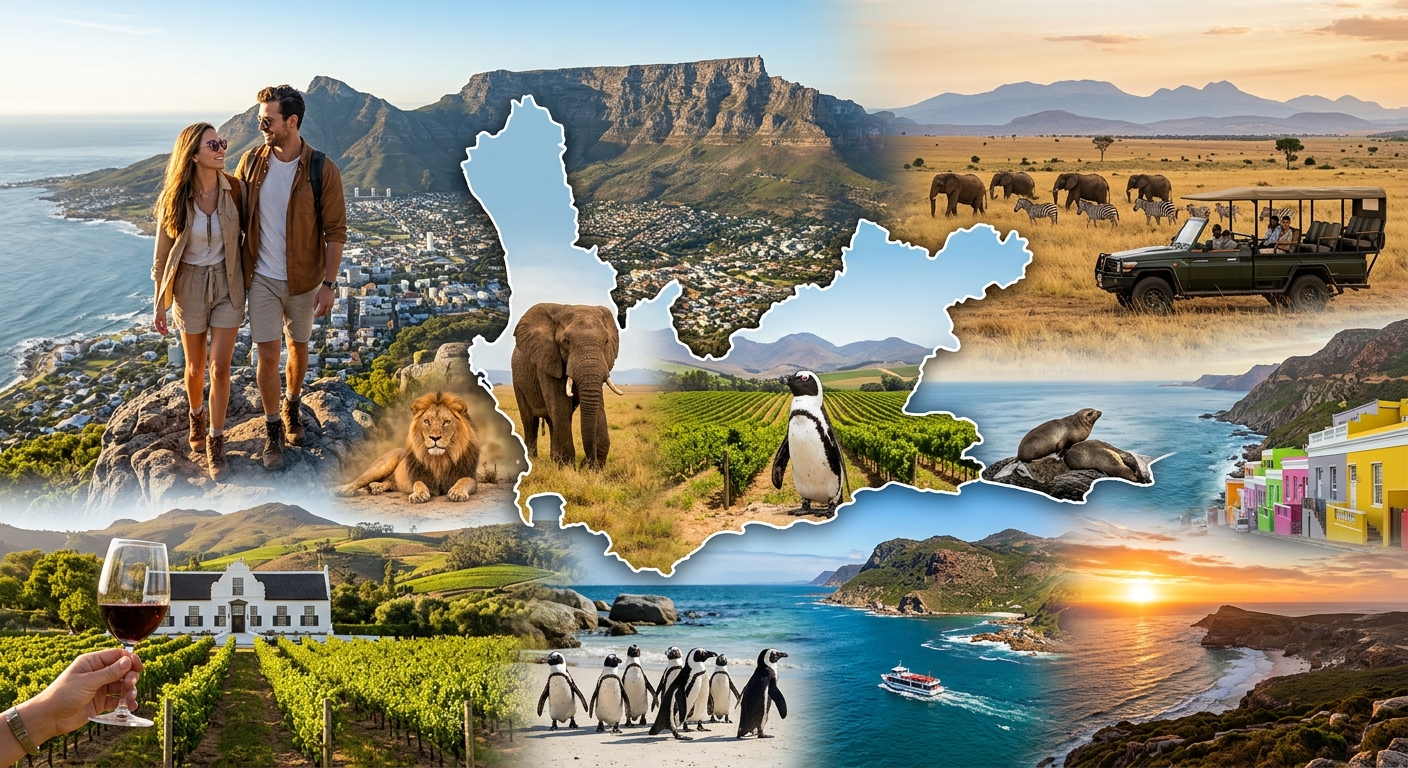
Two weeks is enough time to do the Western Cape properly. You can spend meaningful days in Cape Town, move through the Winelands at a relaxed pace, and still reach the far end of the Garden Route before flying home. Many first-time visitors to the African continent are still weighing their options at this stage, and if you are figuring out where the Western Cape fits into a bigger trip, browsing Africa travel guides can help you frame that decision before narrowing your focus. This itinerary narrows it for you: three regions, fourteen days, and a clear shape for every one of them.
Your 14-Day Western Cape at a Glance
- This itinerary divides your time across three regions: Cape Town (Days 1 to 5), the Winelands (Days 6 to 8), and the Garden Route (Days 9 to 14).
- A hired car is the most practical way to move between regions, though Cape Town's MyCiTi bus handles city travel well.
- Book accommodation at least three months ahead for travel between December and February.
The First Five Days: Getting Cape Town Right
Cape Town has a habit of keeping visitors longer than planned. The city rewards slowness and punishes rushing. Five days here gives you enough time to move past the obvious highlights and settle into your own rhythm.
Choose your base according to budget and preference. The City Bowl puts you close to the V&A Waterfront and the cable car. Sea Point offers a quieter, residential feel with a strong coffee culture and an ocean promenade that fills with life every morning. De Waterkant sits between the two and suits people who want easy access to both sides of the city.
Days One and Two: Table Mountain, the Peninsula, and Penguins
Day one belongs to Table Mountain. Take the cable car early, before the wind picks up and afternoon cloud rolls in from the south. The rotating car gives you a full view over the city, the Atlantic Seaboard, and False Bay as you ascend. The mountain forms part of the Cape Floral Region, which earned its World Heritage listing for harbouring more plant species per square kilometre than almost anywhere else on Earth. Spend the afternoon in the Bo-Kaap, the historic Muslim quarter that runs up the lower slopes of Signal Hill in a sweep of painted houses dating to the eighteenth century. End the evening on Bree Street, which has the best concentration of good restaurants in the city centre.
Day two takes you down the Cape Peninsula. Drive to Boulders Beach near Simon's Town, where a large African penguin colony lives between the granite boulders and the sand in a way that still feels improbable every time you see it. From Boulders, carry on to Cape Point. The road between Simon's Town and the reserve is one of the most dramatic coastal drives you will find anywhere, and the views from the lighthouse over the open ocean are worth the walk up.
Days Three to Five: Flexibility in Cape Town
These three days are for following your interests. Use them across whichever of these options call to you:
- The Zeitz Museum of Contemporary Art Africa at the V&A Waterfront, housed inside a converted grain silo and one of the most significant art institutions on the continent
- Chapman's Peak Drive, a cliff-edge coastal road above Hout Bay with views that change at every bend and some of the best light in the Western Cape at sunset
- The Constantia wine valley, which sits within the city limits and produces some of the Cape's best Sauvignon Blancs and Semillons at estates you can visit without leaving the greater city area
- Robben Island, where Nelson Mandela was held for 18 of his 27 years in prison, reachable by ferry from the V&A Waterfront with tours led by former political prisoners
- Kalk Bay, a fishing village that has grown into one of the Cape's most characterful towns, with independent bookshops, antique dealers, galleries, and a compact but genuinely excellent dining scene
Days Six to Eight: The Winelands at Your Own Speed
The Winelands sit 45 minutes from Cape Town by car. Most visitors treat them as a day trip. Staying overnight changes the experience considerably. You get the estates to yourself before the tour coaches arrive, and evenings in Franschhoek or Stellenbosch have a pace that feels worlds away from the city.
Stellenbosch is the larger and livelier of the two main towns. It has a working university, a solid restaurant scene on Dorp Street and Church Street, and wine estates in every direction from the centre. Franschhoek is more compact, with French Huguenot roots that still show clearly in its architecture and in many of the estate names along the valley. Both deserve at least one night.
On day six, check into Stellenbosch and spend the afternoon visiting two or three estates. Rustenberg and Warwick are reliable choices for first-time visitors to the region. On day seven, move to Franschhoek. The Franschhoek Wine Tram links several valley estates in a hop-on, hop-off format that removes the need for a designated driver. On day eight, take a slow morning in the village before pointing east toward the Garden Route.
Days Nine to Fourteen: The Garden Route, Town by Town
The Garden Route stretches roughly 300 kilometres from Mossel Bay in the west to Storms River in the east. The coastline takes in beaches, lagoons, estuaries, and stretches of ancient indigenous forest. The park authority's official pages cover current trail conditions, permit requirements, and accommodation within the Knysna and Tsitsikamma sections of the national park.
Six days gives you a solid read of this stretch without feeling compressed. Here is how to sequence them:
- Day 9, Mossel Bay. Stop at the Bartolomeu Dias Museum Complex, which marks the spot where the Portuguese explorer rounded the Cape in 1488. The town gets passed over by many travellers, but it makes a calm and affordable entry point to the route with good seafood options near the harbour.
- Day 10, Wilderness. Drive through George and stop in Wilderness, a small town with one of the most genuinely beautiful beaches on the entire route. It is quiet and unhurried, which makes it a good place to decompress after the first driving day.
- Day 11, Knysna. Arrive in time for lunch, then walk out to the Heads, the twin sandstone cliffs at the entrance to the Knysna Lagoon. The town has a long association with oyster farming. Order a dozen and eat near the water. The lagoon at evening light is one of the best views on the Garden Route.
- Day 12, Plettenberg Bay. Plett carries a different energy from the rest of the route, busier and more resort-like in summer. The Robberg Nature Reserve just outside town offers a circular coastal walk with seal colonies below the cliffs and frequent dolphin sightings from the headland.
- Day 13, Storms River and Tsitsikamma. The suspension bridges over the Storms River gorge are the set piece of the Tsitsikamma section. The yellowwood forest here is ancient, dense, and very still. Allow a full morning for the gorge walk and the shorter trails nearby.
- Day 14, Return. Budget five to six hours of driving if you are heading back to Cape Town overland, more if you stop at any of the towns you passed through quickly on the way east. George Airport is the faster option if flights suit your routing home.
Getting Around the Western Cape Without Complications
A hired car is the only realistic choice for this itinerary outside Cape Town. Intercity buses and the Shosholoza Meyl train service exist but run on schedules that do not suit travellers moving between Garden Route towns on fixed dates. Car hire at Cape Town International Airport is straightforward, with major international agencies in the arrivals hall.
Within Cape Town, the MyCiTi bus network covers the Waterfront, Sea Point, the city centre, and several other tourist areas. It runs on a prepaid tap card system and is a safe, predictable way to move around the city without needing a vehicle every day.
Roads between major towns are well maintained and clearly signed. Fuel is considerably cheaper here than in Europe or North America. You drive on the left. The adjustment takes a day at most and then stops registering.
Timing, Costs, and What to Genuinely Expect
Cape Town is most expensive and most crowded from mid-December through late January. South African school holidays push accommodation rates up sharply during this window. Travelling in April, May, or October gives you better prices, fewer crowds, and on the Garden Route, the best conditions for whale watching off the southern coast.
The Western Cape carries no malaria risk. The road infrastructure is reliable. Cape Town has a restaurant culture that can stand comparison with major international food cities, and the same is increasingly true of Franschhoek and Knysna. ATMs are widely available throughout the region. Most accommodation and restaurants accept major international credit cards without issue.
Standard travel awareness applies. Keep valuables out of sight in parked cars. Stay alert in unfamiliar city areas after dark. These are sensible habits for any city visit and not a reason to reconsider the trip.
Fourteen Days That Give the African Continent a Proper Introduction
The Western Cape sits at the accessible end of African travel. The distances are manageable. The roads are good. The food, wine, scenery, and variety of landscape are exceptional, and they shift in character from one day to the next in a way that keeps every morning feeling like a new part of the journey.
By day fourteen, you will have covered three distinct regions at a pace that left room for the unplanned stops, the long lunches, and the slow mornings that nobody writes into an itinerary but everyone remembers afterward. Most people who make this trip start thinking about their return before they've boarded the plane home. That says more about the Western Cape than any itinerary can.