What Franschhoek Is Actually Like
Franschhoek is one handsome street, serious food, and the Winelands' highest prices. Here is when it earns a night and when a day trip is enough.
- Flag
-
- ISO code
- ZA
- Population
- 17,000
- Currency
- ZAR
- Timezone
- Africa/Johannesburg
What Franschhoek is Actually Like
Franschhoek is one handsome street, Huguenot Road, running roughly north to south for about 1.5 kilometres. That is the entire town. Flanking it are Cape Dutch gables, art galleries, chocolate shops, and a concentration of restaurants per capita that is among the highest in South Africa. The valley floor sits at 300 metres above sea level, enclosed by the Wemmershoek Mountains to the west and the Groot Drakenstein Mountains to the east. The whole place feels curated, polished, and expensive. It is.
This is not a spontaneous stop.
Riding the Wine Tram
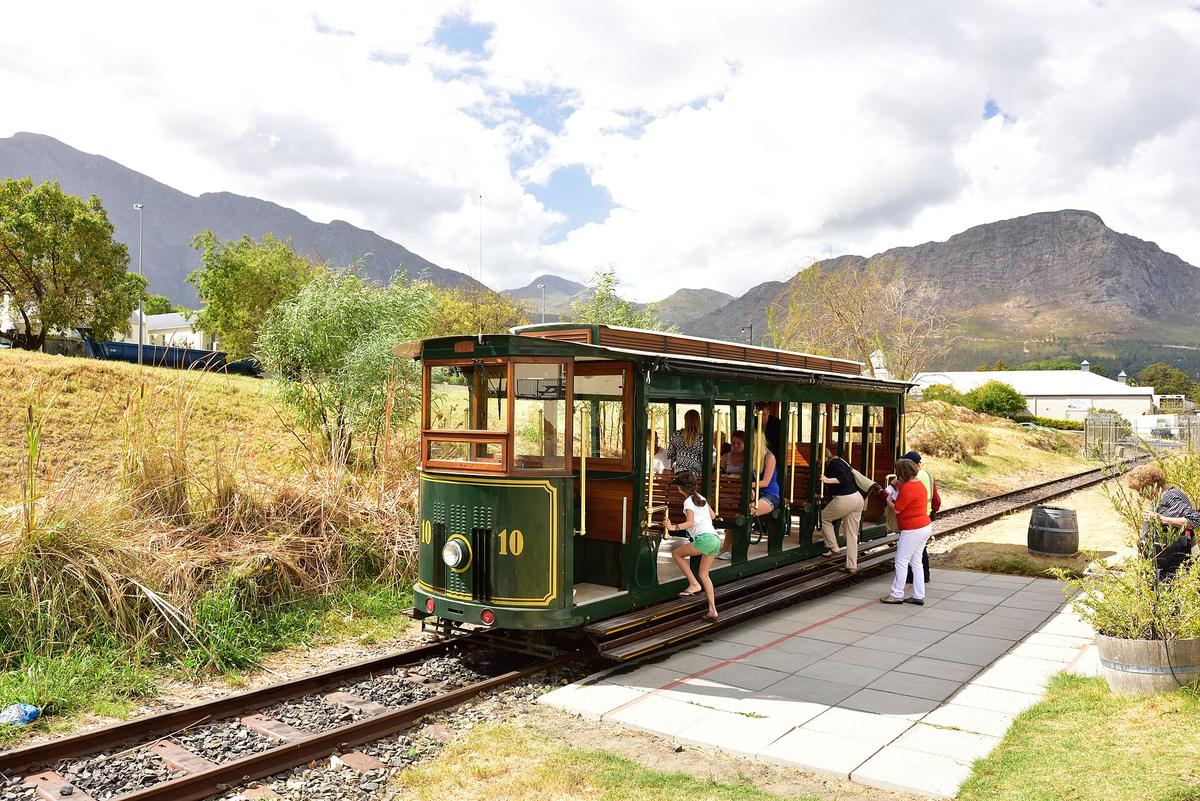
The Franschhoek Wine Tram, launched in 2012, runs four lines from the terminal at 32 Huguenot Road: Blue, Green, Orange, and Red. Each line serves 6 to 8 wine estates. The open-side trams and tram buses operate roughly 10:00 to 17:00. The catch is the last departure from the terminal falls between 11:00 and 12:00 depending on the line. Arrive at 10:30 and you may have missed your window on a busy day. Book your tram ticket online in peak season, December to February, when the valley fills with South African school holidays and international visitors. A day pass costs ZAR 280 to 350 per adult, but that covers only the tram. Estate tasting fees run ZAR 50 to 150 per tasting of 4 to 6 wines, and those are not included. Budget for both.
.jpg)
What it Costs and Why You Pay it
Franschhoek commands the highest prices in the Cape Winelands. A hotel room in a boutique property or vineyard lodge runs ZAR 2,500 to 12,000 per night. Guesthouses are more accessible at ZAR 1,200 to 3,500. Backpacker beds start at ZAR 350 to 600.
The Real Line Item Is Food
La Petite Colombe, at Leeu Estates, charges ZAR 1,200 to 1,800 per person for its tasting menu, excluding wine. Protégé, inside Le Quartier Français, is ZAR 800 to 1,200. These are destinations, not casual lunches. A mid-range main course sits at ZAR 180 to 350, a café breakfast at ZAR 80 to 160, and a flat white at ZAR 35 to 50. You pay for the concentration of talent and the setting. The valley has roughly 45 to 50 wine estates, and the official wine route dates to 1984. The produce is exceptional, the dining rooms are small, and the demand is intense.
Book or Go Hungry
Book restaurants 3 to 6 months ahead in peak season. Show up without a reservation in December and you will eat at the petrol station.
Day Trip or Overnight Splurge
Franschhoek is 75 kilometres from Cape Town, a drive of 1 hour 15 minutes to 1 hour 30 minutes. From Stellenbosch it is 30 kilometres, 35 to 45 minutes. From Paarl it is 25 kilometres, 30 minutes.
Making a Day Trip Work
A day trip is feasible if you book the Wine Tram in advance, arrive at the terminal by 10:00, and accept that you will see one line and possibly a single estate lunch. The alternative: a morning at one estate, a walk down Huguenot Road, a coffee at a café, and the drive back. That works for a quick taste.
Why Stay the Night
The overnight option gives you the late afternoon light on the Franschhoek Pass, the Saturday morning Franschhoek Village Market (09:00 to 14:00 on Huguenot Road), and the chance to eat dinner at a top-end restaurant without rushing back to a car.
Driving the Pass
The pass itself, the R45, climbs 7 kilometres from the town to a summit at 740 metres. The best views come driving southbound toward Villiersdorp, where the valley opens up and the Theewaterskloof Dam appears on the upper southern side. The road is sealed. The gradient hits 1:8 to 1:10 on the steepest sections, and the summer south-easter can gust over 60 km/h. Drive it for the scenery, not for a shortcut. The alternative route via the N1 and Worcester is much longer.
Who Should Choose Franschhoek Over Stellenbosch
Stellenbosch has Dorp Street, an oak-lined historic corridor of galleries and eateries, and a larger, more varied wine scene. Franschhoek is smaller, more concentrated, and almost entirely dedicated to high-end hospitality. Choose Franschhoek when you want a single street where everything is walkable, when your priority is a tasting menu at a restaurant that could hold its own in Cape Town, and when you are willing to pay for a room that is part of the experience. Skip it if you want a cheap base for wine touring, if you dislike the feeling of a curated town, or if you are travelling with children who need playgrounds and space to run. The town has no major hospital; the nearest is in Paarl or Stellenbosch, 25 to 30 kilometres away.
Hiking and Nature
The Mont Rochelle Nature Reserve, on Lambrechts Road, offers about 10 marked hiking trails. Day permits cost ZAR 50 to 80 per person. The trails are steep and the fynbos is best seen May to October. The protea flowering season runs May to October, the erica season autumn to spring. The pass itself sits within the Cape Floral Region UNESCO World Heritage Site, listed in 2004 and extended in 2015. The vegetation is mountain fynbos, proteas, and ericas. The bird life includes Cape sugarbird and orange-breasted sunbird. Snakes include puff adders and Cape cobras in warmer months. Baboons are common and bold. Do not leave windows open or food visible in your car.
Practical Notes
The tap water in town is fine, but in the surrounding Klein Karoo and Overberg towns it can be brackish; carry cash for bottled water in remote areas. The Franschhoek Literary Festival runs in May, the Bastille Festival in July, and the Cap Classique and Champagne Festival in early December. These events spike prices and fill rooms. Book accommodation 3 to 6 months ahead for any of them.
Common Questions
Is Franschhoek worth the higher prices?
Yes, if your priority is a concentrated, high-end food and wine experience in a walkable town. No, if you want budget accommodation or a spontaneous, low-cost day out. The prices reflect the density of top-tier restaurants and boutique lodging, not the size of the town.
How does the Wine Tram actually work?
You buy a per-line, per-day pass for ZAR 280 to 350. The tram runs 10:00 to 17:00, but the last departure from the terminal is 11:00 to 12:00. Each line visits 6 to 8 estates. Tasting fees are extra, ZAR 50 to 150 each. Book the tram and estate visits ahead.
Should I stay overnight or just do a day trip?
A day trip is fine for a single line on the tram or a lunch at one estate. Overnight is better for a tasting-menu dinner, the Saturday market, and the pass views at sunset. The driving time from Cape Town is 1 hour 15 minutes, so either is viable.
Who should choose Stellenbosch over Franschhoek?
Stellenbosch suits those who want a larger town with more varied wine estates, a university energy, and lower accommodation prices. Franschhoek suits those who want a compact, polished, high-end town where everything is on one street and the food is the event.
Read next
-
 Franschhoek Things to Do the Wine Tram the High Street and Is It Worth the Price
Decide if Franschhoek is worth the premium with a guide to the Wine Tram routes, the main road galleries, the Huguenot Memorial and how it compares to Stellenbosch.
Franschhoek Things to Do the Wine Tram the High Street and Is It Worth the Price
Decide if Franschhoek is worth the premium with a guide to the Wine Tram routes, the main road galleries, the Huguenot Memorial and how it compares to Stellenbosch.
-
 Franschhoek Restaurants Worth Booking and the Casual Spots Locals Keep Quiet
From months-ahead tasting menus to same-day farm stall picnics, here is how to eat brilliantly in Franschhoek without overdosing on white tablecloths.
Franschhoek Restaurants Worth Booking and the Casual Spots Locals Keep Quiet
From months-ahead tasting menus to same-day farm stall picnics, here is how to eat brilliantly in Franschhoek without overdosing on white tablecloths.
-
 South Africa Travel Guide, What to Know Before You Go
South Africa delivers raw landscapes and world-class wildlife, but requires more planning than a typical beach getaway. Here's how to start.
South Africa Travel Guide, What to Know Before You Go
South Africa delivers raw landscapes and world-class wildlife, but requires more planning than a typical beach getaway. Here's how to start.
-
 Cape Town vs Johannesburg Which City for Your Days
Which South African city to spend your limited days in, refereed without false neutrality.
Cape Town vs Johannesburg Which City for Your Days
Which South African city to spend your limited days in, refereed without false neutrality.
-
 Best Time to Visit South Africa by Region and Season
South Africa's seasons are inverted, and the Cape's winter rain is opposite the rest of the country. Here's how to time your trip.
Best Time to Visit South Africa by Region and Season
South Africa's seasons are inverted, and the Cape's winter rain is opposite the rest of the country. Here's how to time your trip.
-
 Getting Around South Africa, Why Self-Drive Beats Flying
Self-driving is the best way to see the Cape and Garden Route, but long distances and Gauteng's e-toll system can surprise first-time visitors.
Getting Around South Africa, Why Self-Drive Beats Flying
Self-driving is the best way to see the Cape and Garden Route, but long distances and Gauteng's e-toll system can surprise first-time visitors.